

Blog
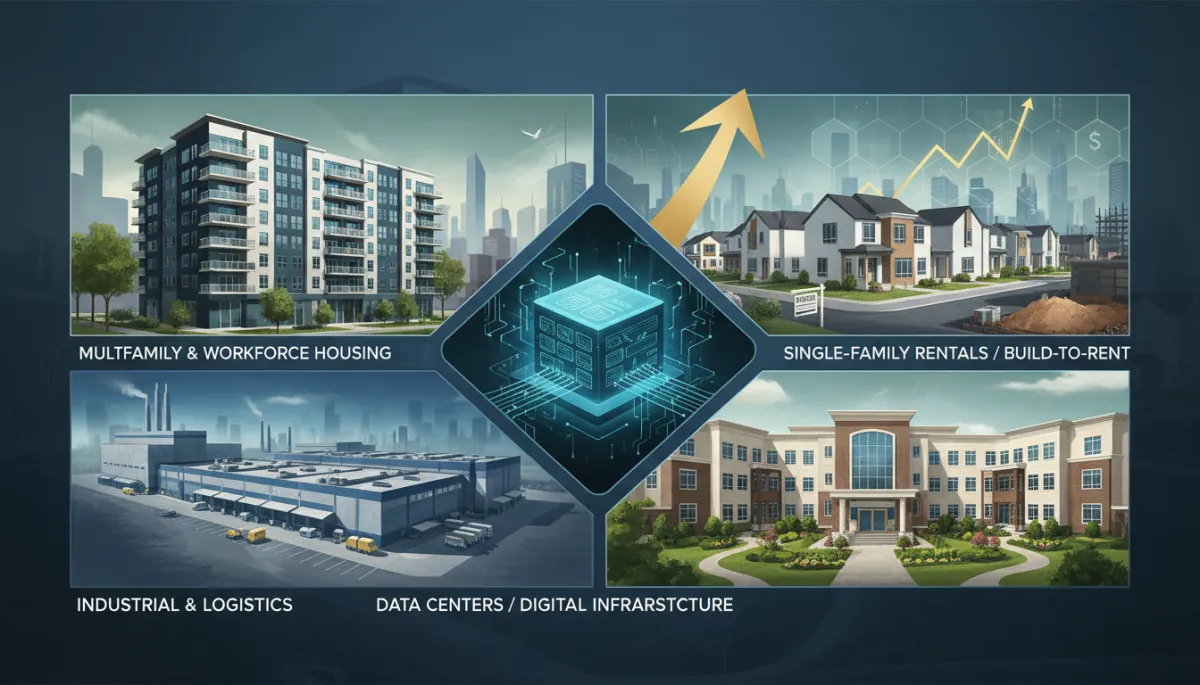
Top Real Estate Asset Classes 2026
As markets adjust to higher-for-longer interest rates, persistent inflation, and rapid technological change, investors are rethinking which real estate asset classes 2026 will deliver durable income and long-term growth. The winners are not chosen by hype, but by structural demand: where people live, work, store goods, and move data. Understanding these dynamics is essential if you want to identify the best real estate investments 2026 and avoid chasing yesterday’s opportunities.
Why Asset Selection Matters More Than Ever in 2026
Over the last decade, a rising tide of cheap capital lifted almost every segment of real estate. That era is over. Today, performance varies sharply between types of real estate asset classes. According to PwC’s Emerging Trends in Real Estate report, industrial and multifamily have significantly outperformed many traditional office and retail properties, a gap that is expected to persist into 2026 and beyond.1
For investors, that means capital allocation is no longer a secondary decision—it is the decision. Choosing the right asset class in the right market can be the difference between stable, inflation-hedged income and a property that struggles to find tenants or financing. In 2026, smart investors are focusing on income producing real estate assets tied to long-term demographic and technological trends, not short-lived speculation.
What Are Real Estate Asset Classes?
A real estate asset class is a category of property that shares similar characteristics, income drivers, and risk profiles. Common examples include residential, industrial, office, retail, hospitality, and specialized sectors like data centers or healthcare. Within each category, there are further niches—such as luxury apartments versus workforce housing, or last-mile logistics versus bulk distribution warehouses.
For investors, understanding types of real estate asset classes is foundational. It helps you:
Align investments with your risk tolerance, time horizon, and income needs
Diversify across sectors that respond differently to economic cycles
Evaluate opportunities using relevant benchmarks, vacancy trends, and rent growth data
Instead of asking “Is real estate a good investment in 2026?” a more useful question is “Which real estate asset classes 2026 best match my strategy, and in which markets?”
Why Asset Classes Matter in Today’s Market
Several powerful forces are reshaping real estate returns between now and 2026: inflation, shifting demand patterns, and technology. Each asset class is affected differently, which is why asset selection is central to modern real estate investment strategies.
Inflation and the Cost of Capital
Inflation has raised operating costs but also pushed rents higher in sectors with strong demand, such as industrial and multifamily. At the same time, elevated interest rates have compressed valuations in weaker segments like commodity office buildings. Assets with short lease terms and strong pricing power—such as apartments and single-family rentals—can adjust rents more quickly, offering better inflation protection than properties locked into long leases without escalation clauses.
Demand Shifts: Where People Live, Shop, and Work
The pandemic accelerated trends that are still playing out in 2026. Remote and hybrid work reshaped office demand and boosted certain suburban and Sun Belt housing markets. E-commerce continues to drive demand for logistics and warehouse space, while aging demographics are increasing the need for senior housing and healthcare facilities.2 Investors who follow these demand shifts—rather than relying on past patterns—are better positioned to identify the best real estate investments 2026.
Technology and Digital Infrastructure
Technology is not only changing how properties are managed (through proptech and smart building systems), it is also creating entirely new asset classes. Data centers, cell towers, and fiber networks are now recognized as core income producing real estate assets, supported by the ongoing growth in cloud computing, AI, and streaming. CBRE and JLL both highlight data centers and life sciences assets as high-conviction sectors heading toward 2026.3

Logistics and industrial assets remain top performers as e-commerce volumes grow.
Top Real Estate Asset Classes in 2026
While no forecast is perfect, multiple industry reports from PwC, CBRE, JLL, and others converge on a similar set of high-conviction sectors. Below are the real estate asset classes 2026 that disciplined investors are prioritizing, along with why they are trending, their key benefits, and the risks to consider.
1. Multifamily and Workforce Housing
Multifamily has been a standout performer for years, and the underlying drivers remain intact heading into 2026. Homeownership affordability is strained in many markets due to elevated mortgage rates and limited supply. Younger households, mobile professionals, and downsizing retirees all contribute to sustained rental demand. Within this category, workforce and affordable housing are particularly resilient, as they serve essential needs rather than discretionary preferences.1
Why it’s trending: Persistent housing shortages, demographic tailwinds, and barriers to new construction in many metros keep occupancy high and rents relatively firm, even in slower economic periods.
Key benefits: Diversified tenant base, relatively short leases that allow for periodic rent adjustments, and strong alignment with basic shelter needs make multifamily a core holding for many portfolios.
Risks and considerations: Local oversupply in certain high-growth markets, regulatory risks (rent control, eviction moratoriums), and rising operating costs can pressure margins. Thorough submarket analysis and conservative underwriting are critical.
📌 Investor insight: In 2026, many investors are shifting from luxury Class A properties to well-located Class B and workforce housing, where demand is deeper and less sensitive to economic cycles.
2. Industrial and Logistics Facilities
Industrial real estate particularly logistics, warehouses, and distribution centers continues to be one of the most favored real estate investment strategies globally. The rise of e-commerce, same-day delivery expectations, and re-shoring of manufacturing have all fueled demand for modern, well-located facilities near major transportation nodes.1
Why it’s trending: Structural shifts in supply chains and consumer behavior are not cyclical; they are long-term. Retailers and logistics providers continue to expand their warehouse footprints to improve resilience and speed.
Key benefits: Typically lower operating expenses than residential, long-term leases with creditworthy tenants, and strong rent growth in key logistics markets have made industrial a core component of institutional portfolios.
Risks and considerations: Some markets have seen a surge in speculative development, raising the possibility of short-term oversupply. Asset obsolescence is also a concern—older buildings without sufficient ceiling heights, loading capacity, or proximity to population centers may underperform.
💡 Pro Tip: Focus on infill and last-mile locations with constrained land supply. These properties are better positioned to maintain pricing power even if new supply comes online in outlying areas.
3. Data Centers and Digital Infrastructure
Data centers have moved from niche to mainstream as one of the most closely watched real estate asset classes 2026. The growth of cloud computing, AI workloads, streaming, and edge computing is driving demand for secure, power-dense facilities with robust connectivity. According to CBRE and JLL, data center vacancy in key hubs remains extremely tight, supporting rent growth and development pipelines.3
Why it’s trending: Every digital interaction—video calls, streaming, AI queries—runs through data infrastructure. As digital consumption grows, so does the need for physical space to house servers and networking equipment.
Key benefits: Long leases, sticky tenants, and high switching costs can create durable income streams. Many data centers also include built-in rent escalations tied to power usage or inflation, supporting returns in a higher-cost environment.
Risks and considerations: High capital intensity, specialized technical requirements, and concentration risk (a few large tenants) make this sector more complex. For most individual investors, access is through REITs, funds, or partnerships rather than direct ownership.
4. Single-Family Rentals and Build-to-Rent Communities
Single-family rentals (SFR) have matured into an institutional-grade asset class, and build-to-rent (BTR) communities—purpose-built neighborhoods of rental homes—are expanding rapidly. Remote work and lifestyle shifts have increased demand for more space, yards, and suburban amenities, especially in high-growth markets highlighted by sources like Forbes and the National Association of Realtors.4
Why it’s trending: Many households are “renters by choice” or “renters by necessity,” priced out of homeownership but seeking the feel of a single-family home. SFR and BTR meet this demand while offering investors stable, long-term tenants.
Key benefits: Strong rent collections, lower turnover in well-managed communities, and the ability to aggregate portfolios across multiple markets. For smaller investors, SFR remains one of the most accessible income producing real estate assets.
Risks and considerations: Operating scattered-site portfolios can be management-intensive. Property taxes, insurance costs, and local regulatory changes (such as restrictions on institutional ownership) can impact returns. Careful market selection and efficient property management are essential.
5. Senior Housing and Healthcare-Adjacent Assets
Demographic trends are clear: populations are aging in the United States and many other developed markets. This is creating long-term demand for senior housing, assisted living, memory care, and medical office buildings. Reports from JLL and other research firms highlight healthcare-related real estate as a key growth area through 2026.3
Why it’s trending: Healthcare services are less discretionary than retail or office usage. As older adults require more care and support, well-located senior communities and medical facilities benefit from stable, needs-based demand.
Key benefits: Potentially resilient cash flows, especially in markets with limited supply and strong local healthcare ecosystems. Many leases are structured with annual escalations and triple-net terms, shifting some expense risk to tenants.
Risks and considerations: Operational complexity is higher than in traditional multifamily or industrial. Performance is closely tied to the quality of the operator, regulatory frameworks, and local competition. Many investors access this sector via specialized operators or REITs rather than direct ownership.
Key Trends Shaping Real Estate Investing in 2026
Across these top sectors, one theme stands out: the shift from speculation to demand-driven investing. Rather than betting on cap rate compression or rapid appreciation, sophisticated investors are focusing on durable cash flow, strong tenants, and real-world usage. Several trends support this approach:
Remote and hybrid work: Office demand remains uneven, pushing investors toward asset classes with clearer occupancy outlooks, such as industrial and housing in growth markets.4
Sustainability and efficiency: Tenants and regulators increasingly favor energy-efficient buildings. Sustainable and green-certified assets can command premium rents and lower operating costs, benefiting net income over time.2
Demographic shifts: Urbanization in some regions, suburban growth in others, and aging populations all influence which locations and property types will see the strongest demand.
📌 Key takeaway: In 2026, the most resilient portfolios are built around essential-use, demand-backed assets—housing, logistics, and digital and healthcare infrastructure—rather than speculative bets on trendier but unproven property types.
How Financing Impacts Investment Success in 2026
Even the best asset class can underperform if the financing structure is wrong. In a higher-rate environment, the cost and flexibility of your capital stack are as important as the property itself. Investors who rely on slow, rigid financing can miss time-sensitive opportunities or be forced to accept unfavorable terms at closing.
This is where specialized lenders like RP Capital Lending make a difference. For active investors building portfolios in the top real estate asset classes 2026—from single-family rentals to small multifamily and mixed-use properties—access to fast, flexible capital can be a strategic advantage, not just a convenience.
Speed to close: Competitive assets in strong markets attract multiple offers. Being able to close quickly with a reliable lending partner helps your offers stand out and reduces the risk of losing deals to better-prepared buyers.
Flexible structures: Investors often need bridge loans, rehab financing, or portfolio loans that traditional banks are hesitant to provide. RP Capital Lending focuses on investor needs, aligning loan terms with your value-add or long-term hold strategy.
Scalability: As you grow from a few properties to a larger portfolio, your financing strategy must evolve. Working with an investor-focused lender helps you plan for future acquisitions, refinances, and recapitalizations without constantly starting from scratch.
💡 Pro Tip: Underwrite deals using conservative interest rate assumptions and stress-test your cash flow. Then, partner with a lender who can execute quickly when the numbers still work under those assumptions.
Putting It All Together: Strategic Investing in 2026 and Beyond
The landscape for real estate asset classes 2026 is more nuanced than a simple “buy or sell” decision. The era of easy gains is behind us, but so is the era of indiscriminate capital flows. Investors who take the time to understand how inflation, demand shifts, and technology affect each sector can build portfolios that are both resilient and opportunistic.
Focus on demand-backed sectors: multifamily and workforce housing, industrial and logistics, data centers and digital infrastructure, single-family rentals, and senior housing and healthcare-adjacent assets.
Prioritize cash flow quality over speculative appreciation. Look for strong tenants, realistic rent growth assumptions, and markets with healthy job and population trends.
Use financing strategically. The right lending partner, such as RP Capital Lending, can help you act decisively on high-conviction opportunities while managing risk.
Ultimately, the best real estate investments 2026 will not be defined by headlines but by fundamentals. Investors who combine clear asset-class selection, disciplined underwriting, and thoughtful financing will be best positioned to grow their portfolios—regardless of short-term market noise. If you are ready to move from theory to action, start by clarifying which asset classes fit your goals, then align your capital and lending relationships to execute with confidence.
Sources:
1. PwC & Urban Land Institute, “Emerging Trends in Real Estate”
2. Realtor.com, “Real Estate Market Outlook 2026”
3. CBRE & JLL, “Real Estate Market Outlook 2026” and sector-specific reports
4. National Association of Realtors & Forbes Real Estate Council, “Real Estate Market Trends 2024” and “Best Places to Invest in Real Estate”


RP Capital Lending is a d.b.a of RP Capital Partners Inc (NMLS # 2469193)
Disclaimer: Loans only apply to non-owner occupied properties. Rates, terms and conditions offered only to qualified borrowers, may vary upon loan product, deal structure, other applicable considerations, and are subject to change at any time without notice.
Copyright © 2025. All Rights Reserved.